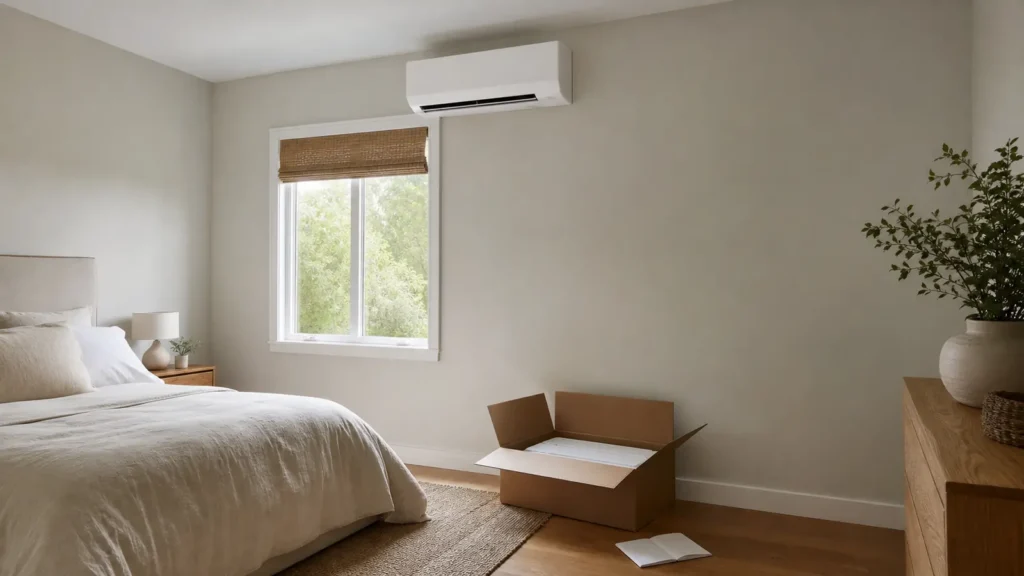
Safety note: Refrigerant and electrical work have legal and safety requirements. Per the EPA, connecting or disconnecting pre-charged refrigerant lines on a mini-split requires Section 608 technician certification. Follow the installation manual, the National Electrical Code and your local code, and use a licensed electrician where your jurisdiction requires one. This is general information, not professional advice.
A ductless mini-split is a heat pump with an outdoor condenser and one or more wall-mounted indoor heads, joined by refrigerant lines and a control cable. “DIY” kits ship with pre-charged line sets, so no vacuum pump or gauges are needed. EPA still requires Section 608 certification to connect them (see below). This guide walks through the decisions in the order they matter, using manufacturer spec sheets and federal guidance.
On this page
The short version
- Size from a load calculation, not square footage. ENERGY STAR says your system size should be verified with “Manual J,” a calculation of the heating and cooling your home needs (ENERGY STAR). See what size mini-split do I need.
- Compare SEER2, EER2 and HSPF2, the ratings used since January 1, 2023 (AHRI). See SEER2, EER2 and HSPF2 explained.
- In a cold climate, check low-temperature capacity. ENERGY STAR’s cold-climate criteria require a COP of at least 1.75 at 5°F and at least 70% of rated heating capacity at 5°F (ENERGY STAR). See cold-climate mini-splits.
- Know the refrigerant rule. EPA says connecting or disconnecting pre-charged lines on a mini-split requires Section 608 technician certification (EPA). See mini-splits and EPA Section 608.
- The federal tax credit has ended for heat pumps installed after December 31, 2025 (ENERGY STAR). See the heat pump tax credit in 2026.
Step 1: Decide what the system has to do
Heating one cold room, cooling a bedroom, or carrying a whole floor are different jobs. DOE’s Building America guide recommends load calculations for each zone (one per indoor unit) and for the whole house (Building America Solution Center). One head per room is simplest; open floor plans may suit one larger head.
Step 2: Size it
Run a Manual J calculation or have one run. DOE’s guidance warns that oversized equipment cycles excessively, runs less efficiently and dehumidifies poorly in summer (DOE cold-climate sizing guide). Our sizing guide explains how to read the result against a spec sheet.
Step 3: Read the ratings
SEER2 is seasonal cooling efficiency, EER2 is full-load cooling efficiency and HSPF2 is seasonal heating efficiency. Higher is better for all three. For heating-heavy climates, HSPF2 and low-temperature capacity matter more than SEER2.
Step 4: Plan the line set and wiring
DIY kits come with fixed-length pre-charged line sets. MRCOOL’s 5th Gen 12k (115 V) ships with a 25 ft line set and lists a maximum line length of 82 ft (MRCOOL). Electrical requirements are printed on the unit: the same 12k model lists a minimum circuit ampacity of 18 A and a 20 A maximum fuse. See line sets and electrical requirements.
Step 5: Check the rules where you live
Beyond EPA Section 608, most jurisdictions require an electrical permit for a new circuit. Ask your local building department before you buy.
Step 6: Estimate what it will cost to run
Running cost depends on how much heat you need, the unit’s HSPF2 and your electricity rate. Our operating cost calculator does the arithmetic and compares the result with electric baseboard, propane, heating oil and natural gas.
Total cost: what to budget beyond the box
| Item | Notes |
|---|---|
| The kit | Indoor head, outdoor unit, pre-charged line set, communication cable |
| Longer line set or coupler | If the included length doesn’t reach |
| Outdoor pad, stand or wall bracket | Above snow line in cold climates |
| Electrical | Circuit, breaker, disconnect, whip; often an electrician and permit |
| Line-set cover and wall sleeve | Protects insulation; seals the penetration |
| Condensate pump | Only if the drain can’t slope down |
| Refrigerant connection by a certified technician | EPA says connecting pre-charged lines requires Section 608 certification |
| Permit fees | Varies by jurisdiction |
We don’t list prices because they vary by region and change often. Get quotes for the electrical and refrigerant parts before you buy the kit.
Mistakes buyers make
- Sizing by square footage alone. Use a load calculation.
- Comparing Region IV ratings in a cold climate. Use Region V figures and capacity at your design temperature.
- Ignoring the circuit. A 230 V unit in a panel with no spare slots can add real cost.
- Assuming “DIY” means no certification. See EPA 608.
- Counting on a tax credit. The federal 25C heat pump credit ended for installs after December 31, 2025. See heat pump tax credit 2026.
FAQ
Can I install a DIY mini-split myself?
Mounting, drilling and routing line sets and control cables are physical tasks many owners can do, but EPA states that connecting or disconnecting pre-charged refrigerant lines requires Section 608 certification, and electrical work must meet code. Read our EPA 608 guide first.
What size do I need?
Whatever a Manual J load calculation says. Manufacturer square-footage ranges are rough guides only.
Is there still a federal tax credit?
No. ENERGY STAR states the 25C credit applied to products purchased and installed from January 1, 2023 to December 31, 2025.