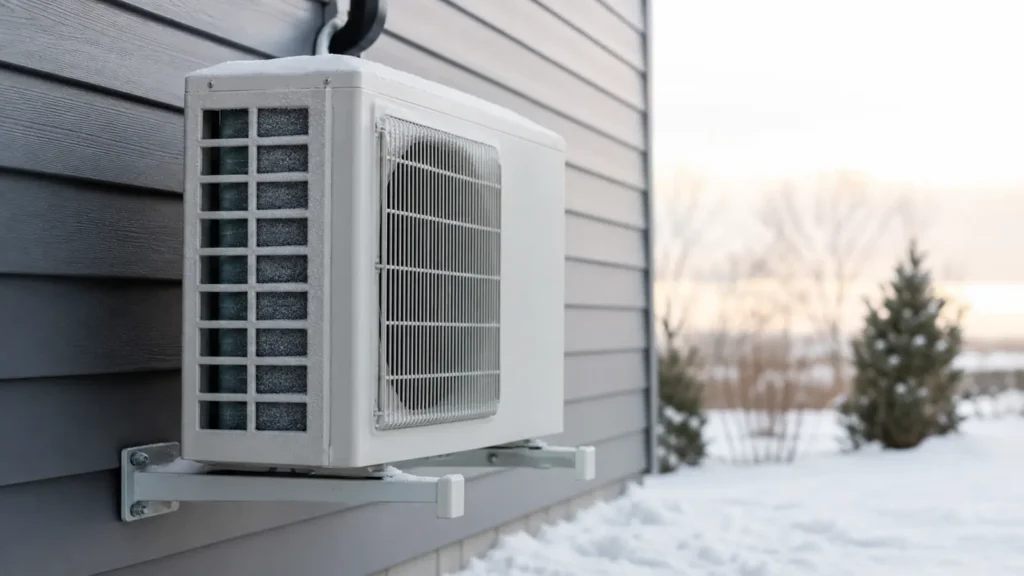
“Cold climate” on a box is marketing until it meets a definition. ENERGY STAR has one.
On this page
The ENERGY STAR cold-climate criteria
From ENERGY STAR’s key product criteria for air-source heat pumps (ENERGY STAR):
- COP at 5°F of at least 1.75. At 5°F the unit must deliver at least 1.75 units of heat per unit of electricity.
- Capacity retention: heating capacity at 5°F must be at least 70% of capacity at 47°F.
- Controls verification: the unit must pass a controls verification procedure.
Operating range is not the same thing
Many spec sheets list a low operating limit. MRCOOL’s operating-range page lists heating operation for its 5th Gen units down to −13°F or −22°F, depending on the model (MRCOOL). That tells you the unit will run at that temperature, not how much heat it delivers there. For capacity at low temperatures, use the manufacturer’s expanded performance data or the ENERGY STAR and NEEP listings.
Sizing for heating
DOE’s Building America guidance says heating-focused sizing in climate zones 4 and up should follow NEEP, NRCan and DOE guidance or Manual S 3rd edition, and that you should not select equipment from AHRI certificate data alone (BASC). DOE’s cold-climate guide adds that accurate design loads matter and that safety factors should not be added on top (DOE).
Backup heat
Below the outdoor temperature where the heat pump’s output no longer meets your heating load (the “balance point”), you may need supplemental heat. Plan it with your load calculation rather than assuming the heat pump covers every hour.
What the 1.75 COP means in practice
A COP of 1.75 means 1.75 units of heat delivered for each unit of electricity, so at 5°F the heat pump uses about 43% less electricity than a baseboard heater for the same heat (1 ÷ 1.75 ≈ 0.57). At milder temperatures the COP is higher. The seasonal HSPF2 rating gives an average: dividing HSPF2 by 3.412 gives a rough seasonal COP, for example 7.6 ÷ 3.412 ≈ 2.2 for the MRCOOL 12k’s Region V rating (MRCOOL).
Capacity retention, worked
If a unit delivers 12,000 Btu/h at 47°F, ENERGY STAR’s 70% capacity criterion means it must deliver at least 8,400 Btu/h at 5°F (ENERGY STAR). If your room needs 10,000 Btu/h at your design temperature, that unit alone isn’t enough even though it’s “12k” and cold-climate certified. That’s why sizing for heating starts from capacity at your design temperature.
Where to find low-temperature data
| Source | What it gives you |
|---|---|
| Manufacturer expanded performance tables (submittal or engineering data) | Capacity and power input at a range of outdoor temperatures |
| ENERGY STAR product finder | Certified models, including the cold-climate designation |
| NEEP cold-climate heat pump list | Capacity and COP at 5°F and other temperatures for listed models |
| AHRI certificate | Ratings at standard conditions; not enough on its own for cold-climate sizing |
Defrost and snow
Below freezing, frost builds on the outdoor coil and the unit periodically runs a defrost cycle, briefly pausing heat. Mount the outdoor unit above expected snow depth on a stand or wall bracket, keep it clear of roof drip lines, and make sure defrost water can drain away without freezing into a block under the unit. Follow the manual’s clearance and mounting instructions.
Backup heat options
- Keep an existing furnace, boiler or baseboard as backup for the coldest hours.
- Use a wood stove or other zone heat in the main living area.
- Choose a larger or second heat pump only if the load calculation supports it.
Plan backup with your contractor using the load calculation, not by assuming the heat pump will or won’t cope.
Checklist
- Find your outdoor design temperature (your Manual J provider has it).
- Look up capacity at that temperature in the manufacturer’s data.
- Check whether the model is listed as ENERGY STAR cold climate.
- Compare the Region V HSPF2 figure. See SEER2 and HSPF2 explained.
FAQ
Do mini-splits work at 0°F?
Many models are rated to run below 0°F, but capacity and efficiency drop as it gets colder. Check the data at your design temperature.
Is “hyper heat” the same as ENERGY STAR cold climate?
Not necessarily. Brand names aren’t certifications; check the ENERGY STAR listing.
Sources
- ENERGY STAR: https://www.energystar.gov/products/air_source_heat_pumps/key-product-criteria
- MRCOOL: https://support.mrcool.com/hc/en-us/articles/40703414617748-Operating-Temperature-Ranges-for-MRCOOL-Systems
- BASC: https://basc.pnnl.gov/resource-guides/cold-climate-heat-pump-sizing-and-selection
- DOE: https://bsesc.energy.gov/sites/default/files/2024-10/Guide%20To%20Sizing%20%26%20Selecting%20Air-Source.pdf
- MRCOOL: https://doxrepo.mrcool.com/mc-diy-5-br-en-01.pdf