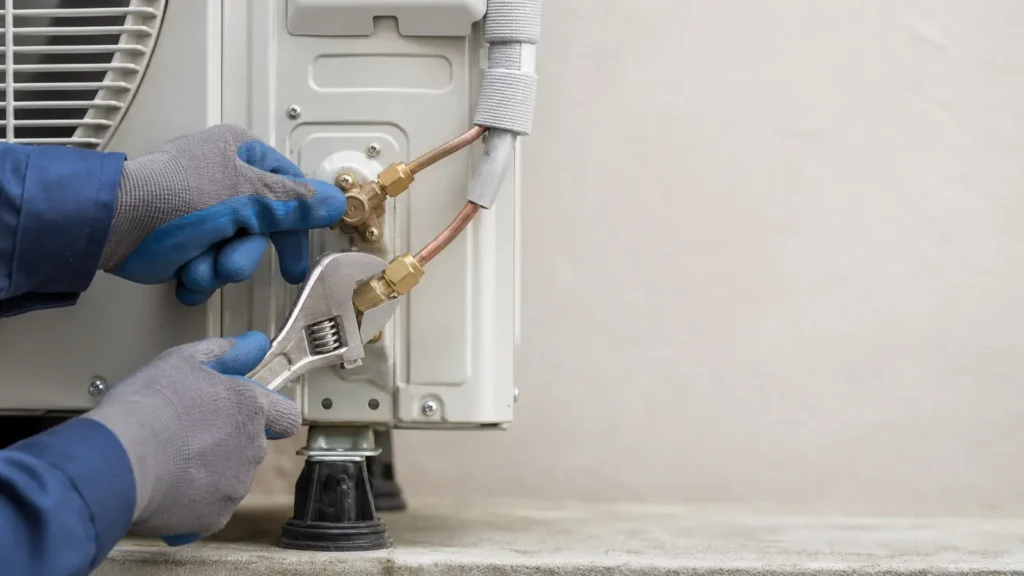
Safety note: Refrigerant and electrical work have legal and safety requirements. Per the EPA, connecting or disconnecting pre-charged refrigerant lines on a mini-split requires Section 608 technician certification. Follow the installation manual, the National Electrical Code and your local code, and use a licensed electrician where your jurisdiction requires one. This is general information, not professional advice.
DIY mini-split kits are often marketed as installable by homeowners. EPA’s own Q&A is the place to start.
On this page
What EPA says
From EPA’s Section 608 Q&A (EPA):
Is technician certification required to install an R-410A mini-split? Yes. Adding or removing refrigerant from a mini-split as part of installation, and/or connecting or disconnecting hoses or pre-charged lines requires a section 608 technician certification.
EPA lists activities “reasonably expected to violate the integrity of the refrigerant circuit,” including attaching or detaching hoses and gauges, adding or removing refrigerant, adding or removing components, and cutting the refrigerant line.
That answer refers to R-410A. Many new systems use R-454B or R-32 instead. Read EPA’s technician certification requirements for the refrigerants and equipment types covered, or ask EPA directly about your unit.
What the marketing says
MRCOOL’s support page for its 5th Gen 12k describes the system as installable with “no professional tools or HVAC experience required” (MRCOOL). That describes the tools needed. Whether you need a Section 608 certification is a separate question, and EPA’s Q&A above is the authority on it.
How certification works
EPA’s certification page describes Type I (small appliances), Type II (high-pressure appliances), Type III (low-pressure appliances) and Universal certification, issued after passing an EPA-approved test (EPA). Residential split systems fall under Type II.
Practical options
- Do the mounting, wall penetration, condensate drain and pad yourself, and hire a certified technician to make the refrigerant connections and start the system.
- Get certified yourself through an EPA-approved certifying organization.
- Hire a contractor for the whole installation.
Ask about warranty terms too: some manufacturers require professional installation or registration for full coverage. Read your warranty.
What the DIY homeowner can usually do
Section 608 covers the refrigerant circuit. Many other parts of the installation are ordinary construction work, subject to local codes and permits:
| Task | Section 608 issue? | Other rules |
|---|---|---|
| Mounting the indoor head bracket | No | Manual |
| Drilling the wall penetration | No | Building code, manual |
| Setting the outdoor unit pad or wall bracket | No | Manual, local code |
| Running the condensate drain | No | Plumbing/building code |
| Electrical circuit and disconnect | No | NEC, local permit; often an electrician |
| Connecting pre-charged line sets | Yes, per EPA’s Q&A | Manual |
| Opening service valves, vacuum, adding refrigerant | Yes | Manual |
Section 608 conclusion from EPA’s Q&A; the other columns are general guidance.
Finding a technician for the refrigerant part
- Ask HVAC contractors whether they’ll do “connect and commission” for a homeowner-supplied DIY kit. Some will; some won’t touch equipment they didn’t supply.
- Ask what they’ll check: leak test, vacuum, opening the valves, verifying operation.
- Get the price and the warranty position in writing.
Getting certified yourself
EPA certification is issued by EPA-approved certifying organizations after you pass a test; the test covers a core section plus the type you need (EPA). Type II covers high-pressure appliances like residential split systems. Certification doesn’t replace the installation manual or local permits, and some areas also license HVAC work separately. Licensing rules vary by state and city; check yours.
Why the rules exist
HFC refrigerants are greenhouse gases, and refrigerant handling is regulated under Clean Air Act Section 608. Leaks and venting release them; that’s what the certification and the venting prohibition aim to prevent. Newer A2L refrigerants such as R-454B and R-32 are also mildly flammable, which adds handling and tool requirements. See R-410A vs R-454B and R-32.
FAQ
Do pre-charged line sets avoid the requirement?
No. EPA specifically names connecting or disconnecting pre-charged lines.
Is electrical work covered by Section 608?
No; electrical work falls under the NEC and local code. See electrical requirements.
Can I buy refrigerant to top off a system myself?
Generally not. EPA restricts the sale of refrigerant for stationary systems such as mini-splits to Section 608-certified technicians, and EPA extended that restriction, which already applied to older ozone-depleting refrigerants, to HFC refrigerants on January 1, 2018. If a system is low, it has a leak, and the leak needs a certified technician to find and repair it (EPA Section 608 Q&A).
Which certification type covers mini-splits?
Usually Type II or Universal. EPA’s Type I certification covers “small appliances,” which are fully manufactured, charged and hermetically sealed in a factory with 5 pounds of refrigerant or less. A split system is connected in the field, so it isn’t a small appliance. Type II covers high-pressure appliances, which includes the R-410A, R-454B and R-32 systems in this guide. Type III covers low-pressure appliances such as many large chillers, which homeowners rarely encounter. Universal certification covers all types (EPA technician certification requirements). When you hire someone for the refrigerant work, ask for their certification card and note the type. Technicians earn certification by passing an EPA-approved test, and Section 608 certifications don’t expire, so an older card is still valid.
Sources
- EPA: https://www.epa.gov/section608/epas-refrigerant-management-program-questions-and-answers-section-608-certified
- technician certification requirements: https://www.epa.gov/section608/section-608-technician-certification-requirements
- MRCOOL: https://support.mrcool.com/hc/en-us/articles/35173218846356-DIY-12k-5th-Gen-Condenser-115v