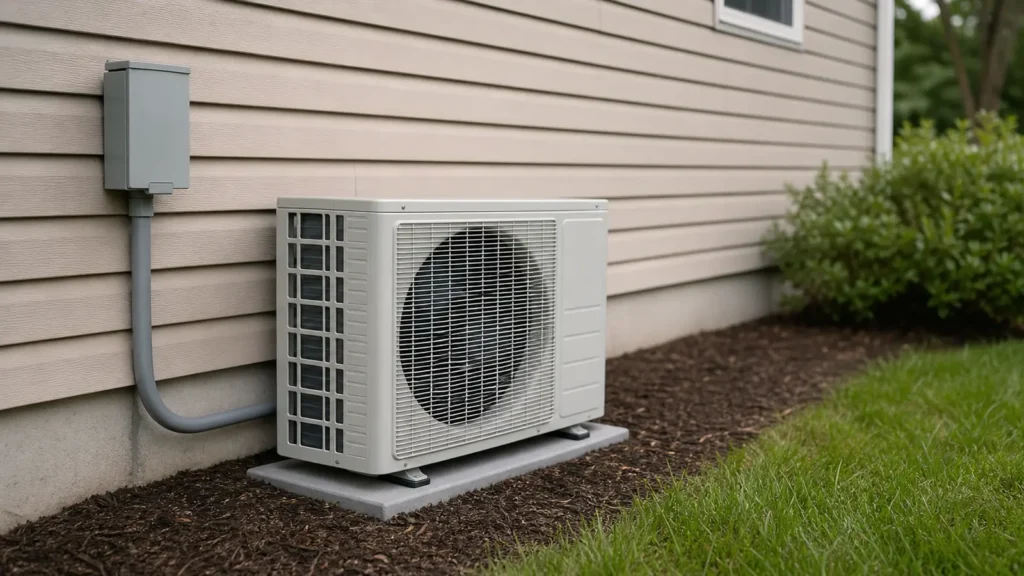
Safety note: Refrigerant and electrical work have legal and safety requirements. Per the EPA, connecting or disconnecting pre-charged refrigerant lines on a mini-split requires Section 608 technician certification. Follow the installation manual, the National Electrical Code and your local code, and use a licensed electrician where your jurisdiction requires one. This is general information, not professional advice.
Every mini-split condenser has a nameplate with the numbers your electrician needs. Here is how to read them.
On this page
The key numbers
| Spec | What it means | MRCOOL 5th Gen 12k (115 V) |
|---|---|---|
| Voltage | Supply voltage the unit needs | 115 V |
| MCA (minimum circuit ampacity) | Used to size the circuit wiring | 18 A |
| Max fuse / max breaker (MOP) | Largest overcurrent protection allowed | 20 A |
Source: MRCOOL support page, checked Oct 12, 2026.
The wire is sized from the MCA, and the breaker must not exceed the maximum fuse rating. For this 12k unit, that means a circuit with a breaker no larger than 20 A. Your electrician picks the wire gauge and breaker using the NEC and local amendments.
Voltage varies by model
MRCOOL’s support page covers a 115 V version of the 12k condenser. Other sizes and models may need 208/230 V. Read the spec sheet for your exact model number before planning the circuit.
Other things to plan
- Disconnect: codes generally require a disconnect within sight of the outdoor unit; your electrician or inspector will confirm what applies.
- Dedicated circuit: follow the manual. Most condensers expect their own circuit.
- Permit: many jurisdictions require a permit and inspection for a new circuit.
Reading a nameplate: worked example
Using the MRCOOL 5th Gen 12k (115 V) figures above:
- MCA 18 A. The circuit conductors must be rated for at least 18 A after any code adjustments. Your electrician sizes the wire from this number, the run length and the NEC tables.
- Max fuse/breaker 20 A. The overcurrent device can’t be larger than 20 A. A 15 A breaker would be below the MCA, so it won’t do.
- Result: a dedicated 115 V circuit with a breaker no larger than 20 A, wired for at least 18 A. The exact wire gauge and breaker type are your electrician’s call under the NEC and local rules.
Air-conditioning equipment is covered by NEC Article 440, which is why the nameplate gives MCA and maximum overcurrent figures rather than a simple “plug” rating.
115 V vs 230 V units
| 115 V | 208/230 V | |
|---|---|---|
| Typical use | Small single-zone units | Most larger and multi-zone units |
| Circuit | Single-pole breaker | Two-pole breaker |
| Current for the same power | About double | About half |
| Panel space | One slot | Two slots |
Larger units draw more power, so they usually run on 208/230 V, which roughly halves the current for the same wattage. Check your panel has space and capacity before buying; a load calculation for the panel is part of a permit in many places.
The disconnect and the service receptacle
- Disconnect: NEC 440.14 generally requires a disconnecting means within sight of the outdoor unit and readily accessible. A fused or non-fused disconnect box beside the condenser is common.
- Service receptacle: NEC 210.63 calls for a 125 V receptacle near heating and cooling equipment for servicing; recent editions set it within 25 ft. Local adoption of NEC editions varies.
- Whip and conduit: the connection from the disconnect to the condenser is usually liquid-tight flexible conduit. Follow the manual’s wiring diagram.
These are summaries; the NEC edition your jurisdiction has adopted, plus local amendments, govern. Exact requirements vary by edition and jurisdiction.
Interconnect cable
On most single-zone systems, the condenser powers the indoor head through a communication/power cable. The manual specifies its type and number of conductors. DIY kits often include it with the pre-charged line set; don’t substitute a different cable without the manual’s approval.
FAQ
Can I plug a mini-split into an existing outlet?
Follow the installation manual. Most are hard-wired on a dedicated circuit.
Does the indoor head need its own circuit?
In most single-zone systems the indoor head is powered through the interconnect cable from the condenser. Your manual’s wiring diagram is the authority.
Does the outdoor unit need a GFCI breaker?
It might. The 2020 National Electrical Code added section 210.8(F), which requires GFCI protection for outdoor outlets at dwellings, and that has included the circuits that feed outdoor HVAC units. Some inverter-driven units caused nuisance trips on GFCI breakers, and later code editions and some state adoptions changed how the rule applies. Which version applies to you depends on the code edition your jurisdiction has adopted and any local amendments. [Verify with your local building department; this varies by jurisdiction.] Ask the inspector before you buy the breaker, and check the installation manual for any GFCI notes from the manufacturer.
What wire runs between the indoor and outdoor units?
The communication (interconnect) cable. MRCOOL Direct, a MRCOOL retailer, says most MRCOOL of its systems use 14/4 stranded wire with 600 V-rated insulation. It isn’t the branch circuit that feeds the condenser, which is sized from the nameplate MCA and maximum fuse (MRCOOL Direct). Use the cable type and length your manual specifies. Plan the length before you order rather than splicing on extra. MRCOOL Direct lists 25, 50 and 75 ft communication cable lengths for MRCOOL systems.