Quick answer
There’s no single best DIY mini-split. Match capacity, ratings, voltage and the line set to your room and climate.
This page shows what to check on any brand’s spec sheet, with one product line as a worked example:
- CapacitySize from a load calculation, not a coverage-area claim
- RatingsSEER2 and HSPF2 are valid only for the certified match
- Voltage115 V vs 208-230 V has to match the circuit
- The connectionEPA Section 608 still applies to pre-charged lines
Instead of declaring one winner for every house, we match the main DIY and value-inverter lines to the install path you’re actually willing to tackle (all figures come from published spec sheets and AHRI certificates, not hands-on lab tests).
Quick picks: DIY kit vs. pro-installed value
Easiest Full DIY
MRCOOL DIY 5th Gen 12k (115 V) — pre-charged 25 ft Quick Connect lines with zero vacuum pump needed.
Pro-Install 115 V Value
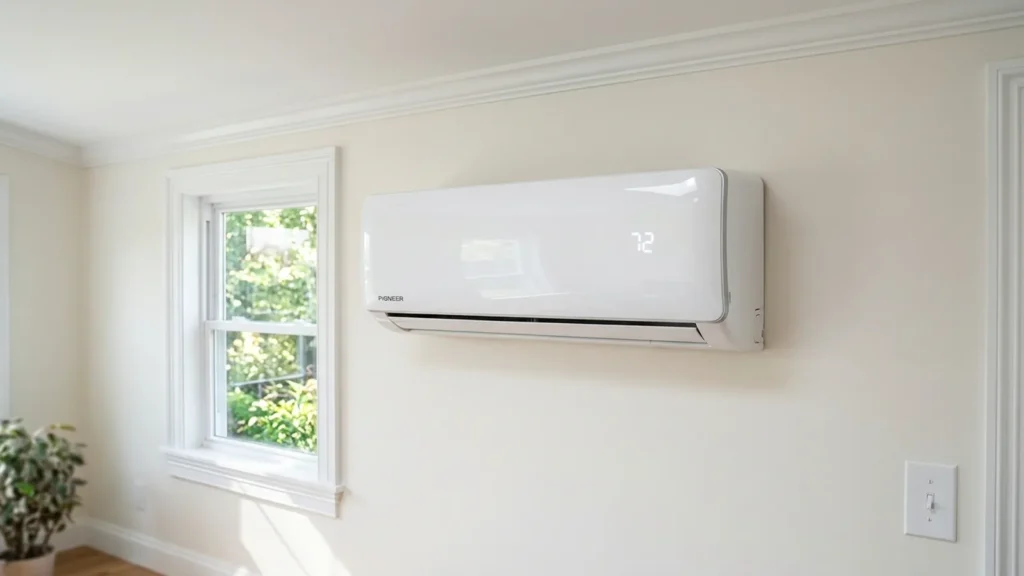
Pioneer Diamante Pro 12k (115 V) — 20.5 SEER2 high-wall inverter for pros or EPA-608 flare & vacuum installs.
Budget Mild-Climate DIY
Della Vario Series 12k — Wi-Fi inverter package suited to moderate heating zones and compact rooms.
Want Local Quotes
Pro-Installed Quote Check — compare written HVAC contractor estimates alongside DIY hardware totals.
On this page
The checklist
Use this list on any brand’s spec sheet before you compare kits.
| Check | Why it matters | Where to find it |
|---|---|---|
| Capacity from a load calculation | Oversized units short-cycle and “waste energy” (BASC) | ACCA Manual J; see what size mini-split |
| Matched AHRI rating | Ratings are valid only for the certified indoor/outdoor match (AHRI) | AHRI Directory; see how to read an AHRI certificate |
| ENERGY STAR | At least 7.8 HSPF2, 15.2 SEER2 and 11.0 EER2 (ENERGY STAR) | ENERGY STAR Product Finder |
| Cold-climate data | Cold-climate bar is 8.5 HSPF2 and 15.2 SEER2, plus low-temp checks (ENERGY STAR) | Spec sheet and ENERGY STAR Product Finder; see cold-climate mini-splits |
| Voltage and circuit | 115 V vs 208-230 V decides your wiring work | Spec sheet: “minimum circuit ampacity” and “maximum fuse” |
| Line set length | Included length vs the distance you actually need | Manual; see line set length |
| Refrigerant connection rules | Connecting pre-charged lines requires Section 608 certification (EPA) | See EPA 608 and DIY |
| Noise | Indoor dB(A) at low speed matters in bedrooms | Spec sheet |
Full wording from the table
- Capacity from a load calculation, Why it matters: Oversized units short-cycle, which “wastes energy and does not provide proper temperature or humidity control” ( BASC )
- Matched AHRI rating, Why it matters: Ratings for a split system are valid only for the certified indoor/outdoor match ( AHRI )
- ENERGY STAR, Why it matters: Split heat pumps need at least 7.8 HSPF2, 15.2 SEER2 and 11.0 EER2 ( ENERGY STAR )
- Cold-climate data, Why it matters: Non-ducted cold-climate criteria are at least 8.5 HSPF2 and 15.2 SEER2, with low-temperature performance checks ( ENERGY STAR )
- Voltage and circuit, Where to find it: Spec sheet “minimum circuit ampacity” and “maximum fuse”
- Refrigerant connection rules, Why it matters: The EPA says connecting pre-charged lines requires Section 608 certification ( EPA )
Worked example: one DIY line’s spec sheet
Here’s how one DIY line publishes its sizes, so you can see what to look for.
| Spec | 9k | 12k | 18k | 24k |
|---|---|---|---|---|
| Cooling capacity (Btu/h) | 9,000 | 12,000 | 18,000 | 24,000 |
| Heating capacity (Btu/h) | 10,000 | 12,000 | 18,000 | 24,000 |
| SEER2 | 23.6 | 23.5 | 22.5 | 22.7 |
| EER2 | 14 | 12.5 | 13.7 | 12.7 |
| HSPF2 Region IV / V | 11.5 / 8.6 | 10.2 / 7.6 | 11.5 / 8.5 | 9.5 / 7.1 |
| Max coverage area* (sq ft) | Up to 400 | Up to 550 | Up to 800 | Up to 1,050 |
| Power supply | 115 V | 115 V | 208-230 V | 208-230 V |
| Min. circuit ampacity / max fuse (outdoor) | 18 A / 20 A | 18 A / 20 A | 18 A / 20 A | 24 A / 25 A |
| Outdoor noise, dB(A) | 54 | 54 | 58.5 | 58.5 |
| Indoor noise, lowest-highest dB(A) | 18-43 | 18-43 | 19-54.5 | 20-54 |
| Refrigerant pipe sizes (liquid/gas) | 1/4 in / 3/8 in | 1/4 in / 3/8 in | 1/4 in / 1/2 in | 3/8 in / 5/8 in |
*MRCOOL: “Max Coverage Area is determined using ideal installation conditions.” Source: MRCOOL DIY 5th Gen brochure (PDF), model numbers DIY-09/12-HP-…-115D25 and DIY-18/24-HP-…-230D25, checked Oct 13, 2026.
The brochure says “all specifications are preliminary and are subject to change during mass production”; confirm against the spec sheet for the exact model number you buy.
The same size from other brands (12k, 115 V)
MRCOOL markets its DIY 5th Gen as a pre-charged DIY kit that needs “no professional tools or HVAC experience” (MRCOOL).
MRCOOL’s own installation manual, however, says “INSTALLATION MUST BE PERFORMED BY AN AUTHORIZED DEALER OR SPECIALIST,” that all wiring “must be installed by a licensed electrician,” and to “Install the unit by following local codes and regulations” (MRCOOL’s own installation manual (PDF)).
Check local permit rules too; see DIY vs pro install.
Pioneer and Senville both call for a qualified installer: Senville’s page says “Professional installation required,” and Pioneer’s installation manual says “Qualified and well-trained personnel must complete the installation” (Pioneer manual (PDF), checked October 22, 2026).
Pioneer’s page says line sets longer than 25 ft need refrigerant added during installation (Pioneer (also on Amazon)). Whatever you buy, see EPA 608 and DIY.
| Spec | MRCOOL DIY 5th Gen 12k | Pioneer Diamante Pro 12k | Senville LETO SENL-12CD |
|---|---|---|---|
| SEER2 / EER2 | 23.5 / 12.5 | 20.0 / 10.5 | 21.2 / 10.1 |
| HSPF2 Region IV / V | 10.2 / 7.6 | 9.5 / 8.2 | 8.7 / 6.7 |
| Refrigerant | R-454B | R-454B | R-454B |
| Line set / pre-charge | Ships with 25 ft line set | 16 ft kit; pre-charged up to 25 ft | Pre-charged for 25 ft |
| Circuit (as listed) | MCA 18 A / max fuse 20 A | 25 A single-pole breaker | MCA 19 A / max fuse 20 A |
| Lowest listed indoor noise | 18 dB(A) | 28 dB(A) (mute) | 17.5 dB (weighting not stated) |
| Maker’s install note | Marketed as DIY; manual requires an authorized dealer or specialist | Refrigerant must be added for line sets over 25 ft | “Professional installation required” |
The table compares 12k, 115 V systems. MRCOOL markets the 5th Gen as DIY. Pioneer calls for a qualified installer, and Senville requires professional installation. Full header wording and the longer install-note cells are in the toggle.
Full wording from the table
- Maker’s install note, MRCOOL DIY 5th Gen 12k (marketed as DIY): Marketed as needing “no professional tools or HVAC experience”; its installation manual says “INSTALLATION MUST BE PERFORMED BY AN AUTHORIZED DEALER OR SPECIALIST”
- Maker’s install note, Pioneer 20 SEER2 Diamante Pro 12k (maker calls for a qualified installer): Refrigerant must be added during installation for line sets over 25 ft
Sources: MRCOOL brochure and support page (above); Pioneer product page; Senville product page; Pioneer and Senville checked Oct 13, 2026.
Noise figures may not be directly comparable: Senville lists “dB” without a weighting, while MRCOOL and Pioneer list dB(A). Specs change; confirm against the spec sheet and AHRI certificate for the exact model. No brand is ranked here.
MRCOOL DIY Select
MRCOOL’s DIY Select is a Quick Connect, R-454B single-zone line in 9k, 12k, 18k and 24k sizes. MRCOOL calls it the most cost-effective option in its DIY lineup, with SEER2 up to 17.5 and a 1-year parts, 2-year compressor warranty.
The 12k 115 V system (outdoor DIYS-12-HP-C-115A11-O, indoor DIYS-12-HP-WMAH-115A13-O) is the fairest comparison with the 5th Gen, Pioneer and Senville 12k units above.
It ships with an 11.5-foot pre-charged Quick Connect line set; longer sets are sold separately.
| Spec | MRCOOL DIY Select 12k 115 V | MRCOOL DIY 5th Gen 12k 115 V (from the table above) |
|---|---|---|
| SEER2 / EER2 | 17.5 / 8.5 | 23.5 / 12.5 |
| HSPF2 Region IV / V | 9.0 / 6.8 | 10.2 / 7.6 |
| Refrigerant | R-454B | R-454B |
| Line set included | 11.5 ft Quick Connect | 25 ft line set |
| Circuit (outdoor, as listed) | MCA 19.5 A / max fuse 20 A | MCA 18 A / max fuse 20 A |
| Lowest listed indoor noise | 17.5 dB(A) | 18 dB(A) |
| Warranty (maker) | 1-year parts, 2-year compressor | See the 5th Gen brochure linked in Sources |
DIY Select figures: MRCOOL’s DIY Select brochure, read November 16, 2026. The brochure says specifications are preliminary and may change during mass production; confirm the exact model sheet. No brand is ranked here.
MRCOOL Monoblock
The MRCOOL Monoblock MTHP (model MDM10115D) is a 115 V all-in-one heat pump with no outdoor condenser. MRCOOL says the system arrives pre-charged with R-32, so there is no line set to connect, and that installation uses two 8-inch wall openings for intake and exhaust plus a condensate drain.
- MRCOOL lists 10,000 Btu/h cooling and 9,000 Btu/h heating, 15 SEER2, 9.9 EER2 and 7.5 HSPF2, with sound from 32 to 46 dB(A).
- The official support page lists a 1-year parts warranty and a 1-year remote warranty.
- Voltage is standard 115 V; the support page lists 13 A minimum circuit ampacity and a 20 A maximum fuse.
This is a different kind of unit than the split systems in the tables above. It can fit rooms where an outdoor condenser is not allowed, but the rated efficiency is lower than the DIY 5th Gen and DIY Select splits, and the heating capacity is 9,000 Btu/h.
Confirm the size against a load calculation.
Monoblock figures are from MRCOOL’s product page, support article for MDM10115D, and installation blog, all read November 16, 2026. No brand is ranked here.
One more 12k, 115 V DIY kit: Zone Air
Zone Air sells its 12k as a DIY kit with pre-charged quick-connect lines. The EPA’s Section 608 rule on the refrigerant connection still applies.
| Spec | Zone Air 12k (ZDIY-MK1-12I + ZDIY-MK1-12O), sold as DIY |
|---|---|
| SEER2 / EER2 | 23.0 / 13.0 |
| HSPF2 Region IV / V | 10.0 / 8.6 |
| ENERGY STAR cold climate | Not found on ENERGY STAR’s list on Oct 31, 2026 |
| Heat at 5°F | Maker lists a COP of 2.1 |
| Maker’s heating low limit | −13°F |
| Refrigerant | R-454B |
| Line set | 16 ft pre-charged set included; up to 75 ft |
| Warranty and install condition | 5-year parts, 7-year compressor; not tied to pro install (maker) |
Full wording from the table
- Warranty and install condition, Zone Air 12k (ZDIY-MK1-12I + ZDIY-MK1-12O), sold as DIY: 5-year parts, 7-year compressor; the maker says it isn’t conditional on professional installation
Also considered (pro install): Cooper & Hunter Olivia 12k (CH-R12OLVWM-115VI + CH-RES12-115VO) and ACiQ 12k (ACIQ-12WS-HP115C + ACIQ-12ZS-HP115C) are 115 V 12k systems with ratings close to Zone Air’s, but their warranties assume a contractor.
Those ratings are SEER2 23.2, HSPF2 10.4 / 7.6, 7,300 Btu/h at 5°F on NEEP, R-454B, line sets up to 82 ft, not ENERGY STAR cold climate.
Cooper & Hunter’s applies only to units installed by a licensed HVAC technician, registered within 60 days of installation.
ACiQ gives a 12-year compressor and 7-year parts warranty with online registration, and a factory-authorized, EPA-certified contractor must diagnose any claim; ACiQ’s submittal lists a −13°F heating low limit while its product page says −5°F (Cooper & Hunter, ACiQ).
Sources, all read Oct 31, 2026: Zone Air 12k 115 V and its spec sheet; Cooper & Hunter CH-R12OLVWM-115VI support page and warranty policy; ACiQ 12k 115 V and ACiQ warranties; NEEP; ENERGY STAR mini-split data.
The Cooper & Hunter and ACiQ systems carry identical NEEP figures; the listings don’t say why.
Zone Air’s spec sheet says the system is ENERGY STAR certified and NEEP-listed, but neither list returned a Zone Air model when we checked; confirm in the ENERGY STAR Product Finder. No brand is ranked here.
Brands without a DIY version
Mitsubishi, Daikin and Fujitsu sell their mini-splits for contractor installation.
Mitsubishi’s residential warranty covers products “installed by a licensed heating, ventilation and air conditioning (HVAC) contractor,” and Daikin’s AURORA brochure says, “Always use a licensed installer or contractor to install this product. Do not try to install the product yourself.”
Fujitsu’s Orion XLTH+ 12k uses flare connections. None of the three lists a retail price on the pages we read, so the price comes from contractor quotes. Their cold-climate 12k systems are compared on our cold-climate mini-splits page.
What this example shows:
- Two voltages in one line. The 9k and 12k run on 115 V; the 18k and 24k need 208-230 V. See electrical requirements.
- Efficiency isn’t flat across sizes. The 12k’s Region IV HSPF2 (10.2) is lower than the 9k’s and 18k’s (11.5).
- “Coverage area” is a best case. The maker says it assumes ideal installation conditions. Size from a load calculation instead.
Ductless or ducted?
ENERGY STAR says mini-splits are “specifically designed for homes or sections of homes that do not have ductwork,” and suggests a ducted heat pump if you already have ducts (ENERGY STAR). See ducted vs ductless.
If you’re weighing contractor-installed brands such as Mitsubishi, Fujitsu, Daikin, LG, Gree or Midea instead of a DIY kit, see mini-split brands compared.
Shopping links
Compare kits only after you know the capacity and voltage you need: Shop DIY mini-splits on Amazon →.
MRCOOL DIY 5th Gen at HVACDirect:
- Check price at HVACDirect (9k) →
- Check price at HVACDirect (12k) →
- Check price at HVACDirect (18k) →
- Check price at HVACDirect (24k) →
MRCOOL DIY Select 12k (115 V) and Monoblock at HVACDirect:
- Check price at HVACDirect (DIY Select 12k, 115 V) →
- Check price at HVACDirect (Monoblock 10k, 115 V) →
For other brands’ ductless systems, like the Pioneer unit above: Compare mini-splits at HVACDirect →.
Senville’s specs here come from its LETO 12k (115 V) pages on senville.com. Check current price at HVACDirect, and confirm on that listing which model number and kit it includes: Check price at HVACDirect (Senville LETO 12k, 115 V) →
Check live HVACDirect, Pioneer, or Della links above for current online kit pricing, and compare at least two written local HVAC quotes before choosing between a quick-connect DIY kit and a pro-installed unit.
If the kit you want has to be installed by a pro, we can pass a quote request to Angi, which connects you with local HVAC companies. Get local HVAC quotes through Angi →
FAQ
Is a DIY kit as efficient as a contractor-installed system? The ratings come from the certified matched system. Installation quality still matters; BASC says performance “depends heavily upon proper sizing and quality installation” (BASC).
Can I really install it myself? Mounting and wiring may be DIY where local code allows. The EPA’s Section 608 rule applies to the refrigerant connection (EPA).
How is DIY Select different from DIY 5th Gen? On the 12k 115 V models, MRCOOL lists 17.5 SEER2 and 9.0 HSPF2 (Region IV) for Select, versus 23.5 SEER2 and 10.2 HSPF2 for 5th Gen.
Select ships with an 11.5-foot Quick Connect line set and a 1-year parts, 2-year compressor warranty. Both are R-454B Quick Connect systems. Confirm the exact model sheet before you buy.
Is the MRCOOL Monoblock a mini-split? It is a DIY heat pump, but it is not a split system. All of the components sit in one wall-mounted unit, with no outdoor condenser and no line set.
MRCOOL lists 15 SEER2 and 9,000 Btu/h of heating for the 10k model. Size it from a load calculation, not from the split-system tables above.
Single-zone or multi-zone? See single-zone vs multi-zone.
Sources
- ENERGY STAR Ductless Heating & Cooling
- ENERGY STAR heat pump key product criteria
- DOE Building America Solution Center: Ductless Mini-Split Heat Pumps
- AHRI: Air Conditioners and Heat Pumps
- MRCOOL DIY 5th Gen brochure (PDF)
- EPA Section 608 Q&A
- Pioneer 20 SEER2 Diamante Pro 12k (115 V) product page (checked Oct 13, 2026)
- Senville LETO SENL-12CD product page (checked Oct 13, 2026)
- MRCOOL’s own installation manual (DIY 5th Gen) (PDF) (checked Oct 13, 2026)
- Zone Air 12k 115 V (read Oct 31, 2026)
- Cooper & Hunter CH-R12OLVWM-115VI and warranty policy (read Oct 31, 2026)
- ACiQ 12k 115 V and ACiQ warranties (read Oct 31, 2026)
- NEEP cold-climate heat pump list (read Oct 31, 2026)
- Mitsubishi residential limited warranty (PDF) (read Oct 31, 2026)
- Daikin AURORA R-32 brochure (PDF) (read Oct 31, 2026)
- Fujitsu 12KTAP1 submittal (PDF) (read Oct 31, 2026)
- MRCOOL DIY Select product page (read November 16, 2026)
- MRCOOL DIY Select brochure (PDF) (V.09.04.26, read November 16, 2026)
- MRCOOL DIY Select 18k support page (warranty wording, read November 16, 2026)
- MRCOOL Monoblock product page (read November 16, 2026)
- MRCOOL Monoblock MDM10115D support page (read November 16, 2026)
- MRCOOL Monoblock installation blog (two 8-inch wall openings, read November 16, 2026)