Safety note: Refrigerant and electrical work have legal and safety requirements. Per the EPA, connecting or disconnecting pre-charged refrigerant lines on a mini-split requires Section 608 technician certification. Follow the installation manual, the National Electrical Code and your local code, and use a licensed electrician where your jurisdiction requires one. This is general information, not professional advice.
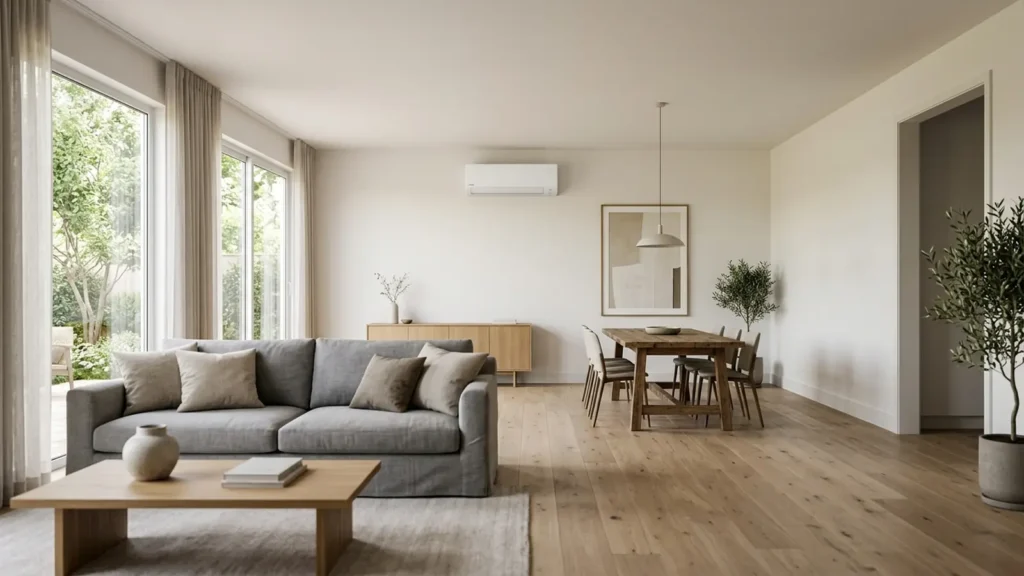
18,000 and 24,000 Btu/h units usually serve large open rooms, a main living area or a garage conversion. In the example line below, both are 208-230 V. The differences show up in efficiency, wiring, line set size and weight.
On this page
Size it first
Get an ACCA Manual J load calculation; ENERGY STAR says your contractor should verify system size with one (ENERGY STAR). As a rough cross-check only, ENERGY STAR’s room AC chart lists 18,000 Btu/h for 700-1,000 sq ft and 24,000 Btu/h for 1,400-1,500 sq ft, assuming 8-ft ceilings (ENERGY STAR).
Spec comparison (one DIY line)
| Spec | 18k | 24k |
|---|---|---|
| Cooling / heating capacity (Btu/h) | 18,000 / 18,000 | 24,000 / 24,000 |
| SEER2 / EER2 | 22.5 / 13.7 | 22.7 / 12.7 |
| HSPF2 Region IV / V | 11.5 / 8.5 | 9.5 / 7.1 |
| Max coverage area* | Up to 800 sq ft | Up to 1,050 sq ft |
| Power | 208-230 V, 1 ph | 208-230 V, 1 ph |
| Min. circuit ampacity / max fuse | 18 A / 20 A | 24 A / 25 A |
| Refrigerant charge (R-454B) | 44.80 oz | 67.37 oz |
| Pipe sizes (liquid/gas) | 1/4 in / 1/2 in | 3/8 in / 5/8 in |
| Outdoor unit net weight | 93.48 lb | 122.80 lb |
| Outdoor noise dB(A) | 58.5 | 58.5 |
*”Determined using ideal installation conditions.” Source: MRCOOL DIY 5th Gen brochure (PDF), checked Oct 13, 2026; the brochure notes all specifications are preliminary and subject to change.
What the differences mean
- Heating efficiency drops noticeably at 24k in this line: Region V HSPF2 is 7.1 vs 8.5. For the same seasonal heat, that’s about 20% more electricity (8.5 ÷ 7.1 ≈ 1.20). See SEER2 and HSPF2 explained.
- The circuit is different. 18 A MCA / 20 A max fuse vs 24 A / 25 A. Confirm breaker and wire size with the installation manual and your electrician; see electrical requirements.
- Line sets aren’t interchangeable. Pipe sizes differ, so couplers and extensions must match the model. See line set length.
- Mounting. A heavier outdoor unit needs a pad or bracket rated for it.
One big head or two smaller ones?
ENERGY STAR notes heat moves with difficulty through an open doorway and can’t move through a closed one (ENERGY STAR). If the 24k is meant to cover several rooms, compare it with two smaller heads on a multi-zone system. See single-zone vs multi-zone.
Compare: Shop 18,000 BTU mini-split on Amazon → · Shop 24,000 BTU mini-split on Amazon →
Prices: we don’t list prices because they vary by region and change often (site policy, Oct 13, 2026). Use the check-current-price links and get local quotes for installation.
FAQ
Is a 24k always better for a big room? Only if the load calls for it. Oversizing causes short cycling and poor humidity control (BASC).
Can either run on 115 V? Not in this line; both list 208-230 V.