Safety note: Refrigerant and electrical work have legal and safety requirements. Per the EPA, connecting or disconnecting pre-charged refrigerant lines on a mini-split requires Section 608 technician certification. Follow the installation manual, the National Electrical Code and your local code, and use a licensed electrician where your jurisdiction requires one. This is general information, not professional advice.
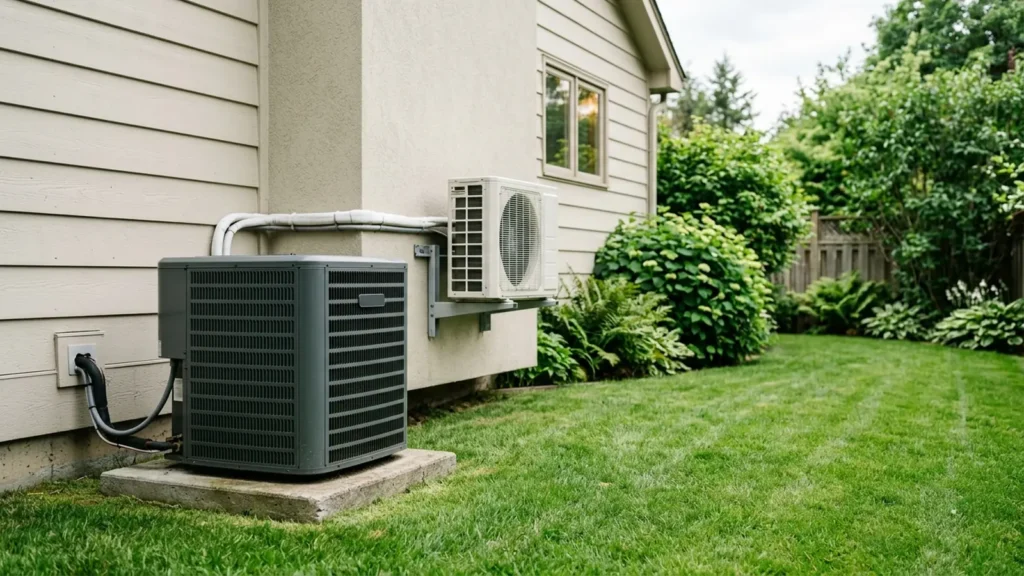
Both are air-source heat pumps. A central heat pump uses your ducts and one air handler; a mini-split puts heads in individual rooms. ENERGY STAR describes a ducted heat pump as “a central air conditioner that also works in reverse to provide whole-house space heating in winter” (ENERGY STAR).
On this page
The decision usually comes down to ducts
| Your house | ENERGY STAR / DOE guidance | Likely fit |
|---|---|---|
| Forced-air ducts already | A central heat pump “can use pre-existing ductwork” and can often be “a drop-in replacement” for an AC or furnace (ENERGY STAR) | Central heat pump |
| Radiators or baseboard, no ducts | Mini-splits fit “older homes with no existing ductwork … that have never had central air conditioning” (ENERGY STAR) | Mini-split |
| Ducts in a vented attic or crawlspace | Duct losses can exceed 30% of heating and cooling energy (BASC) | Either; move ducts inside conditioned space (or seal and insulate them), or go ductless |
| Hot or cold rooms, an addition | Mini-splits suit “additions or outbuildings” and rooms with hot or cold spots (ENERGY STAR) | Mini-split to supplement |
| Newer furnace, old AC | ENERGY STAR suggests a heat pump paired with the furnace as a dual-fuel system (ENERGY STAR) | Central heat pump (dual fuel) |
How they differ in use
- Zoning: each ductless head operates independently, so different areas can sit at different temperatures (BASC).
- Air distribution: a central system reaches every room with a register. With ductless, rooms without a head can be uncomfortable (BASC).
- Filtration: standard mini-split mesh filters capture fine particles poorly; ask about the MERV rating of filters compatible with either system (BASC).
- Fan energy: ductless needs less, because it doesn’t push air through ducts (BASC).
- Backup heat: for cold climates, ENERGY STAR says a cold-climate heat pump keeps working below 5°F, but pairing it with a backup source is most efficient at even lower temperatures (ENERGY STAR). See cold-climate mini-splits.
Comparing ratings
ENERGY STAR’s base criteria for split-system heat pumps are at least 7.8 HSPF2, 15.2 SEER2 and 11.0 EER2. For the cold-climate designation, non-ducted splits need at least 8.5 HSPF2 and ducted splits at least 8.1 HSPF2 (ENERGY STAR). Compare matched-system ratings on the AHRI certificate; see how to read an AHRI certificate.
Sizing
Both need a Manual J. ENERGY STAR says your contractor “should verify the proper size system for your home using a tool called ‘Manual J'” (ENERGY STAR). See what size mini-split.
Compare: Shop diy mini split on Amazon →
Prices: we don’t list prices because they vary by region and change often (site policy, Oct 13, 2026). Use the check-current-price links and get local quotes for installation.
FAQ
Can a mini-split heat a whole house? ENERGY STAR says mini-splits “can be utilized for whole home heating and cooling” (ENERGY STAR), often with multiple head units. Layout and closed doors matter.
Which is cheaper to run? It depends on ratings, duct losses and your rates. See mini-split operating cost.