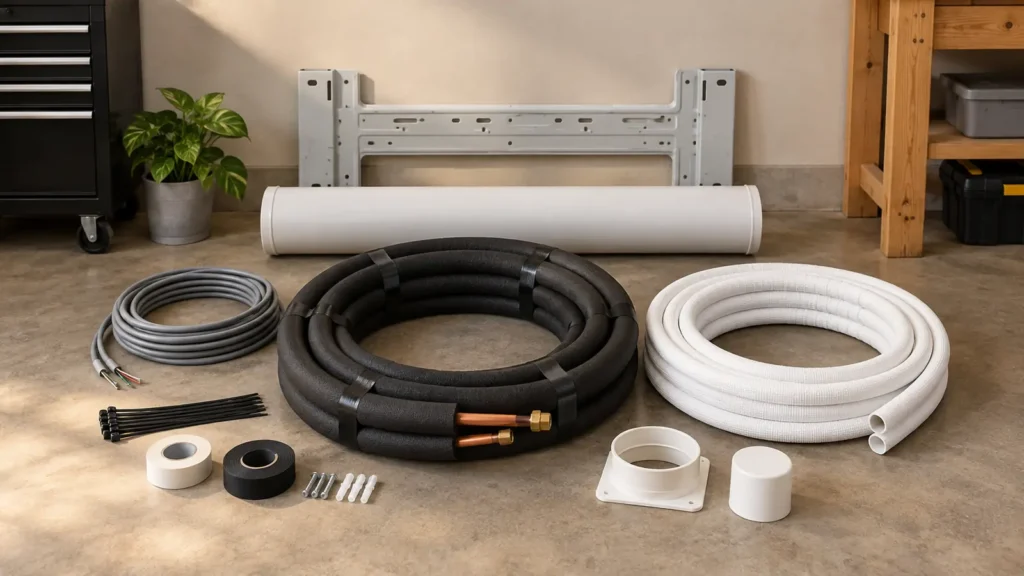
Safety note: Refrigerant and electrical work have legal and safety requirements. Per the EPA, connecting or disconnecting pre-charged refrigerant lines on a mini-split requires Section 608 technician certification. Follow the installation manual, the National Electrical Code and your local code, and use a licensed electrician where your jurisdiction requires one. This is general information, not professional advice.
Installation prices vary too much by region to quote here, but the things that move an installation quote up or down are written down in manufacturer manuals and DOE guidance. Use this list to compare quotes line by line and to see which parts of the job you can’t legally or safely skip.
On this page
The short version
The equipment is only part of the job. Senville’s product page says it plainly: “Installation labour and building-specific materials are not included. An installation may require additional line length, drainage equipment or electrical work” (Senville). Each of those, plus refrigerant work, mounting, permits and the number of zones, is a separate cost driver.
1. Who does the refrigerant work
This is the biggest fork in the road.
- Pre-charged quick-connect DIY systems. MRCOOL’s DIY line uses pre-charged Quick Connect line sets and says you can install it “without needing specialized training or expensive tools” (MRCOOL brochure (PDF)). However, the EPA says connecting or disconnecting pre-charged refrigerant lines requires Section 608 certification (EPA). The same MRCOOL manual also carries the warning “INSTALLATION MUST BE PERFORMED BY AN AUTHORIZED DEALER OR SPECIALIST” (MRCOOL manual (PDF)). Read our Section 608 article before you plan a fully DIY install.
- Flare-connection systems that need vacuuming. Pioneer’s product Q&A says you “will need to remove the air from the lines before releasing the refrigerant from the outdoor unit, using a vacuum pump or the Kwik-e-vac flushing kit that we sell” (Pioneer (also on Amazon)). Della’s FAQ says its lines “are not pre-vacuumed” and must be vacuumed during installation (Della). Della offers Mini Split Math readers 5% off with code MINISPLITMATH at checkout.
- Professional install required. Senville’s LETO page says the R454B system “must be installed and commissioned by a professional with the qualifications required in the installation jurisdiction” (Senville).
DOE’s Building America guide notes that “refrigerant charging must be done by an EPA certified technician” (BASC).
2. Line-set length beyond the factory charge
Most single-zone outdoor units are charged for a set line length. Past that length, the installer has to add refrigerant.
| Brand / model page | Factory charge covers | Source |
|---|---|---|
| Della Vario 12k | Up to 24.5 ft of line set | Della |
| Pioneer Diamante Pro 12k | Up to 25 ft per circuit | Pioneer |
| Senville LETO | 25 ft standard length; extra charge per foot beyond | Senville manual (PDF) |
The Senville manual gives the added R454B charge as 0.16 oz/ft for a 1/4 in liquid line and 0.32 oz/ft for a 3/8 in liquid line beyond the 25 ft standard length (Senville manual (PDF)). A longer run means more line set, more charging work and often more wall penetrations.
Senville’s specs here come from its LETO 12k (230 V) pages on senville.com. Check current price at HVACDirect, and confirm on that listing which model number and kit it includes: Check price at HVACDirect (Senville LETO 12k, 230 V) →
3. Electrical work
Follow the manual’s circuit requirements. BASC notes that some 115/120 V units draw little enough current to go on lightly loaded existing 15 A or 20 A circuits, while larger units need their own 208/230 V circuit (BASC). Breaker sizes vary: Pioneer’s Diamante Pro 12k calls for a 15 A double-pole breaker (Pioneer), and Senville’s SENL-12CD/220 lists a 15 A maximum fuse (Senville). If your panel has no space or capacity, the quote may grow to include panel work. BASC lists “assess the home’s electrical system and perform any upgrades needed” as a separate step (BASC). Both the MRCOOL and Senville manuals say “all wiring must comply with local and national electrical codes and must be installed by a licensed electrician” (MRCOOL manual (PDF); Senville manual (PDF)).
4. Mounting the outdoor unit
The MRCOOL and Senville manuals both allow anchoring the outdoor unit “to the ground or to a wall-mounted bracket” (MRCOOL manual (PDF); Senville manual (PDF)). A pad, a ground stand or a wall bracket are separate materials. In snowy areas, BASC recommends installing outdoor units “well above snow height” (BASC). See our pad vs wall bracket guide.
5. Condensate drainage
The indoor head makes water in cooling and dry modes. The outdoor unit makes water when it defrosts in heating mode. If gravity drainage to outside isn’t possible, the job needs another way to get rid of the water, which Senville lists among possible extras (“drainage equipment”) (Senville).
6. Sizing and design
BASC calls for an ACCA Manual J load calculation before choosing equipment (BASC). Some contractors include this in the quote and some charge for it separately. Ask for it in writing.
7. Number of zones and heads
Each additional head adds a wall penetration, a line set, a signal cable and a drain. See our single-zone vs multi-zone guide.
8. Permits and inspection
Both the MRCOOL and Senville manuals tell you to install “by following local codes and regulations” (MRCOOL manual (PDF); Senville manual (PDF)). Permit and inspection fees, if your jurisdiction charges them, are part of the cost. See our permit guide.
Quote checklist
Ask every installer to itemize:
- Equipment model numbers (indoor and outdoor), with the AHRI certificate number (AHRI Directory)
- Load calculation method
- Line-set length and any added refrigerant
- Evacuation and leak/pressure testing (see our vacuum and pressure test guide)
- Electrical: circuit, breaker, disconnect, any panel work
- Outdoor mounting: pad, stand or bracket
- Condensate routing
- Permit and inspection
- Warranty registration (several makers require it; see our lifespan guide)
Compare kits: Shop DIY mini-splits on Amazon → · Shop mini-split line sets on Amazon →
Prices change often and vary by region, so check current prices with retailers and get written quotes for installation.
When you’re ready to compare install quotes, we can pass your request to Angi, which connects you with local HVAC companies. We pass the request along; we don’t do the install. Get local HVAC quotes through Angi →
FAQ
Is a DIY mini-split always cheaper to install? It removes labour from the quote, but the EPA’s Section 608 rule still applies to connecting refrigerant lines (EPA), and both the MRCOOL and Senville manuals say wiring must be installed by a licensed electrician (MRCOOL manual (PDF); Senville manual (PDF)).
Why do two quotes for the same size differ so much? Compare the line items above. Line length, electrical upgrades, mounting and drainage differ from house to house.
Sources
- Senville SENL-12CD/220 product page
- Senville LETO Series Installation Manual (PDF)
- MRCOOL DIY Series Single-Zone Installation & Owner’s Manual (5th Gen documentation) (PDF)
- Pioneer Diamante Pro 12,000 BTU 230V product page
- Della Vario Series 12,000 BTU product page
- MRCOOL DIY 5th Gen brochure (PDF)
- DOE Building America Solution Center: Ductless Mini-Split Heat Pumps
- EPA Section 608 Q&A
- AHRI Directory of Certified Product Performance