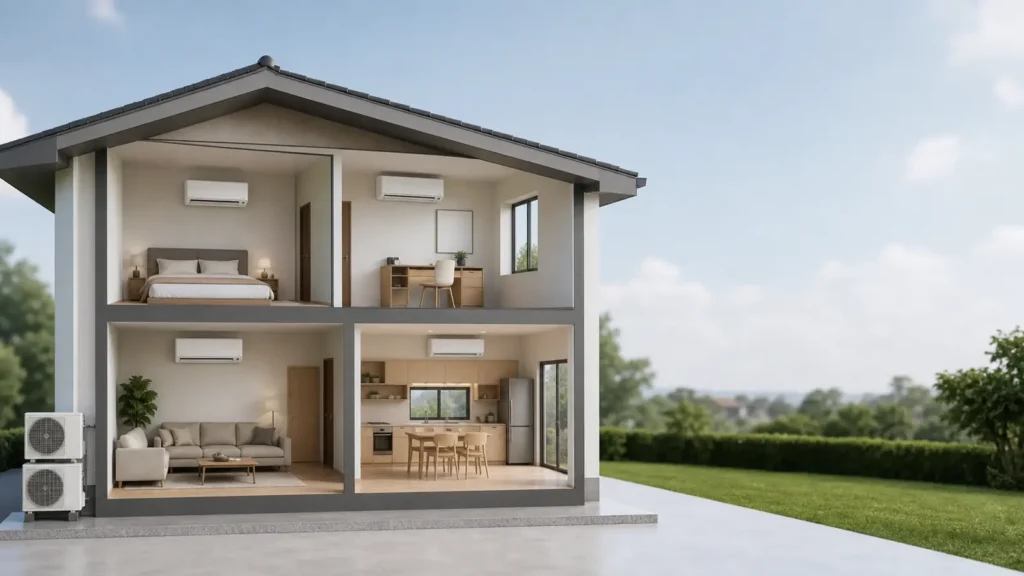
One outdoor unit per indoor head (single-zone), or one outdoor unit feeding several heads (multi-zone)? DOE guidance has a clear view.
On this page
What DOE recommends
DOE’s cold-climate sizing guide (DOE) says:
- Don’t choose multi-zone equipment only because it’s convenient.
- If the smallest available heads are bigger than your room loads, consider serving several rooms with one larger zone instead.
- In general, consider more outdoor units, each with lower capacity and fewer zones. The guide says this improves part-load performance, gives you resilience if one needs service, and typically has little impact on system cost.
Why head size matters
Every indoor head has a minimum output. In a small, well-insulated bedroom, even the smallest head may be oversized, which leads to short cycling. Run ACCA Manual J–style room-by-room loads first (BASC).
Comparison
| Factor | Single-zone (one per room) | Multi-zone |
|---|---|---|
| Outdoor units | One per head | One for several heads |
| Part-load operation | Each unit matches its own room | Shared compressor serves all heads |
| If a unit fails | Only that room loses heat | Every connected room is affected |
| Wall space outside | More condensers | Fewer condensers |
| Line runs | Short, direct | Longer runs to some rooms |
A practical approach
- Calculate ACCA Manual J–based loads for each room.
- Group rooms that share air (open plans) into one zone.
- Use single-zone units where loads differ a lot or where resilience matters.
A worked layout example
Imagine a small house with an open living-kitchen area (heating load 14,000 Btu/h from Manual J) and two bedrooms (3,000 Btu/h each). The numbers are an example.
- Option A: one multi-zone outdoor unit with three heads. Even the smallest wall head is often rated well above 3,000 Btu/h, so the bedroom heads would be oversized and cycle on and off; when only one bedroom calls for heat, the shared compressor runs at a small fraction of its capacity.
- Option B: one single-zone unit sized for the living area, with bedroom doors left open or a transfer fan, plus electric resistance or another small heat source for the bedrooms on the coldest nights.
- Option C: two single-zone units, one for the living area and one larger head placed to serve both bedrooms through a hallway, if the layout allows.
DOE’s guide favors options like B and C over A: fewer, right-sized zones and more outdoor units with fewer heads each (DOE). The right answer depends on your loads and floor plan.
Cost and installation trade-offs
| Consideration | Single-zone | Multi-zone |
|---|---|---|
| Equipment | More outdoor units | One outdoor unit, more expensive per unit |
| Electrical | A circuit per outdoor unit | One circuit for the outdoor unit |
| Line sets | Short, one per unit | One per head, some long |
| Efficiency ratings | Rated per matched pair on AHRI | Rated for specific combinations; check the AHRI certificate for your exact heads |
| Service | One room down at a time | All rooms affected |
Electrical work for either layout must follow the manual, the NEC and local code, with a licensed electrician where required; see electrical requirements.
Ratings to check on a multi-zone system
A multi-zone system’s SEER2 and HSPF2 depend on the combination of heads connected. Look up the AHRI certificate for the exact outdoor unit and set of heads, not just the outdoor unit’s headline rating (AHRI Directory).
Questions to ask a contractor quoting multi-zone
- What are the room-by-room loads, and what is each head’s minimum output?
- What is the AHRI-certified rating for this exact combination of heads?
- What happens to the other rooms if the outdoor unit fails?
- How long is the longest line run, and is it within the manual’s limits?
- Would two or more single-zone units cost much more here?
Planning each zone of a multi-zone system
Because each head has its own line set, plan zone by zone before you order. A planning checklist from MRCOOL Direct, a MRCOOL retailer, for DIY multi-zone systems asks for, per indoor unit (MRCOOL Direct):
- The exact indoor-unit model.
- The line-set diameter that model requires.
- The actual planned route to the condenser, not the straight-line distance.
- The line-set length.
- The communication-cable length.
- Whether a coupler is needed.
- Whether the finished run stays within the system’s limits.
A bedroom head near the condenser and a living-room head on the far side of the house may need different line sizes and lengths. Don’t order identical line sets for every zone. Couplers don’t remove the limits either: MRCOOL Direct notes that a multi-zone system can limit both each indoor unit’s run and the total piping across the system.
FAQ
Are DIY multi-zone kits available?
Yes; some makers sell DIY multi-zone condensers with pre-charged lines. The same sizing logic applies. Under current EPA rules, connecting or disconnecting pre-charged refrigerant lines requires Section 608 technician certification, even on DIY-labeled kits. See EPA Section 608.
Does each head on a multi-zone system get its own line set?
Yes. Each indoor unit connects to the outdoor unit with its own line set, so a three-head system means three runs, each sized for that head’s connection and each with its own length limit. A multi-zone outdoor unit also has a total piping limit across all the heads, so check both numbers in the installation manual (MRCOOL Direct line-set guide).