Safety note: Refrigerant and electrical work have legal and safety requirements. Per the EPA, connecting or disconnecting pre-charged refrigerant lines on a mini-split requires Section 608 technician certification. Follow the installation manual, the National Electrical Code and your local code, and use a licensed electrician where your jurisdiction requires one. This is general information, not professional advice.
Mini-splits have no burners to service, but filters, coils and drains still need attention. Here’s a checklist built from DOE’s Building America guide and ENERGY STAR. Follow your unit’s manual first.
On this page
Owner tasks
| Task | How often | Source |
|---|---|---|
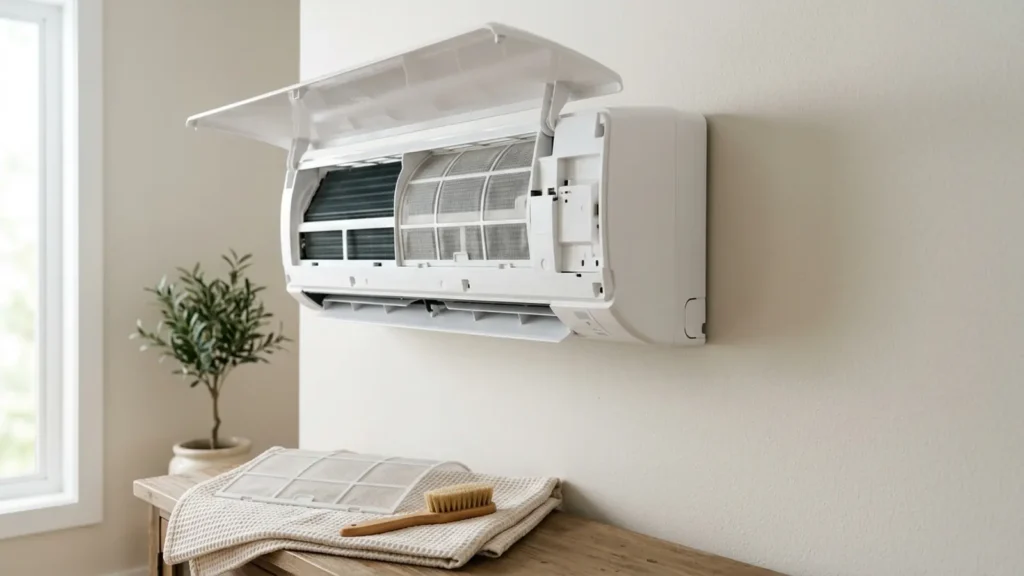
| Clean washable mesh filters (vacuum or wash) | About every two weeks for many standard filters | BASC |
| Clean filters when the filter light says so or they’re visibly dirty | As needed | ENERGY STAR |
| Clean or replace any add-on filters | Per the filter maker | BASC |
| Keep the outdoor unit’s airflow clear (shrubs, snow, debris) | Ongoing | ENERGY STAR |
Shop mini split cleaning kit on Amazon →
Contractor tasks (annual check-up)
ENERGY STAR recommends “annual pre-season check-ups,” cooling in spring and heating in fall (ENERGY STAR). Its general check-up checklist includes (several items are in its cooling-specific section):
- Tighten electrical connections and measure motor voltage and current.
- Inspect the condensate drain; “a plugged drain can cause water damage in the house.”
- Check controls and the start-up cycle.
- Clean evaporator and condenser coils; dirty coils make the system “run longer, increasing energy costs.”
- Check the refrigerant charge; too much or too little “will make your system less efficient.”
- Clean and adjust blower components; airflow problems “can reduce your system’s efficiency by up to 15 percent.”
Refrigerant work requires EPA Section 608 certification (EPA).
Deep cleaning the indoor head
BASC describes a deeper cleaning of wall units for mold and biofilm: removing the blower wheel, brushing and vacuuming the coil, spraying a cleaner between the fins and wiping the air path, vanes and condensate tray, using a foaming sprayer and a “mini-split bib” (BASC). BASC cautions that it is “not recommended to shortcut the deep cleaning by simply using an aerosol can of foaming evaporator cleaner” (BASC). Consider hiring a technician.
Operating habits that help
From ENERGY STAR’s savings tips for mini-splits (ENERGY STAR):
- Use the heat pump year-round if you have both it and a furnace or boiler.
- Pick a steady temperature; heat pumps “do not save energy by turning it down when you’re away or asleep.”
- Avoid Auto mode; set Heat or Cool.
- Use auto fan or the lowest fan speed that spreads the air enough.
FAQ
Can I hose off the outdoor unit? Follow the manual; coil cleaning is on ENERGY STAR’s contractor list.
Why does my head smell musty? Mold and biofilm on the coil, blower or drain tray are a common cause, which the BASC deep-clean addresses (BASC).