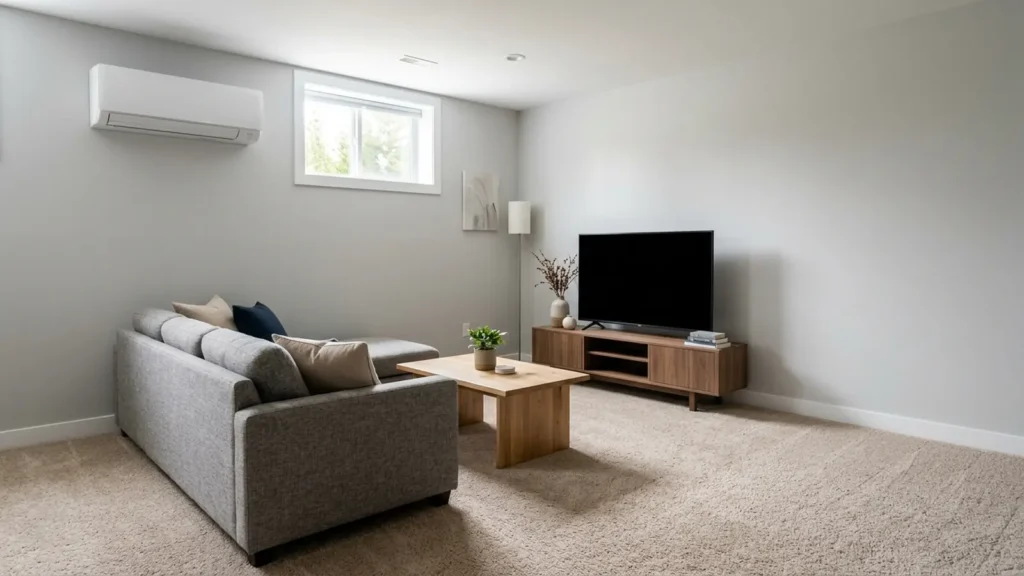
Safety note: Refrigerant and electrical work have legal and safety requirements. Per the EPA, connecting or disconnecting pre-charged refrigerant lines on a mini-split requires Section 608 technician certification. Follow the installation manual, the National Electrical Code and your local code, and use a licensed electrician where your jurisdiction requires one. This is general information, not professional advice.
Finished basements often run cold in winter and damp in summer, and extending ducts down there isn’t always practical. DOE’s Building America guide calls ductless heat pumps “an excellent choice” when a basement “will be converted to living space” (BASC).
On this page
Loads in a basement are different
- Heating may lead. Below-grade spaces often need more heating than cooling, but only a Manual J will tell you for your basement.
- Cooling load is often small. That makes oversizing easy.
- Humidity matters. DOE’s guide lists “dehumidification performance” among the factors for choosing ductless vs ducted (BASC).
Your contractor should size the system with a Manual J load calculation (ENERGY STAR).
Don’t oversize for a damp space
ENERGY STAR explains the problem for room ACs: an oversized unit “will cool the room before it has a chance to remove the humidity,” leaving it “damp and clammy” (ENERGY STAR). BASC says oversized mini-split heads short-cycle and don’t provide “proper temperature or humidity control” (BASC). A right-sized unit avoids the short cycling BASC links to poor humidity control. A basement with a persistent moisture problem may still need a dehumidifier and moisture control.
Head placement
- Heat rises: a wall head in a basement heats the space, and some of that heat drifts up the stairs. ENERGY STAR notes “heat rises and cool air sinks” when planning which areas a head will serve (ENERGY STAR).
- Closed doors block air. Heat “can be challenging” to move through an open doorway and is “impossible” through a closed one (ENERGY STAR). A basement bedroom behind a door may need its own head.
- Floor-mounted console units are also available (BASC); some owners prefer them on short basement walls.
Line set and condensate
- Basements can make routing easy: ENERGY STAR suggests running the line set “through closets, basement/attic stairways, attached garages, basements, crawlspaces, or attics” to minimize wall patching (ENERGY STAR).
- Below-grade heads may not have a gravity drain path. Plan for a condensate pump if the drain can’t slope down. See line set length.
Multi-zone or separate system?
If the main floor already has a multi-zone outdoor unit with spare capacity, BASC says the existing system “may have sufficient capacity” for an added space, to be confirmed by a whole-house Manual J (BASC). See single-zone vs multi-zone.
Compare: Shop 9,000 BTU mini-split on Amazon → · Shop mini-split condensate pumps on Amazon →
Prices: we don’t list prices because they vary by region and change often (site policy, Oct 13, 2026). Use the check-current-price links and get local quotes for installation.
FAQ
Will a mini-split dry out my basement? It removes moisture when cooling, and many units have a dry mode (check your manual). It’s not a substitute for fixing water intrusion.
What size for a basement? Whatever the load calculation says; basements often need less cooling than floor area suggests.