Every comparison uses the manufacturer’s published spec sheet or federal guidance.
How we compare
Every comparison uses published figures: SEER2, EER2, HSPF2 for Region IV and Region V, line sizes, factory refrigerant charge, voltage and maximum line length. We note where two of a maker’s own documents disagree (MRCOOL’s support page and brochure give different room-size ranges for the 12k, for example) and go by the AHRI certificate when ratings are in question.
Sizes within one product line
MRCOOL DIY 5th Gen sizes compared puts the 9k to 36k units side by side. Bigger units in a line often have lower ratings; in that line, SEER2 runs from 23.6 (9k) to 18 (36k). Size by load first (an ACCA Manual J calculation), then compare ratings among units that fit the load.
System layout
Single-zone vs multi-zone covers DOE’s guidance: don’t choose multi-zone only for convenience; consider more outdoor units with fewer heads each for better part-load performance and resilience; and if the smallest heads are bigger than your room loads, consider serving several rooms with one zone.
Comparing two units yourself
- Get the AHRI certificate for each exact indoor/outdoor combination.
- Compare heating capacity and COP at your design temperature from the maker’s performance tables.
- Compare Region V HSPF2 if you have cold winters.
- Check voltage, circuit and line-set limits against your house.
- Estimate running cost for each with the operating cost calculator.
- Then compare price, warranty terms (some require professional installation) and support.
We don’t test equipment, and companies can’t pay to change a comparison.
Ratings belong to combinations
AHRI certifies a rating for a specific outdoor unit paired with specific indoor units, so the same condenser can carry different SEER2 and HSPF2 numbers depending on the head it’s matched with. On multi-zone systems, ratings can also change with the mix of indoor unit types, such as wall heads versus ducted air handlers. Before comparing two systems, find the AHRI certificate for the exact combination you’ll install (AHRI Directory).
Cold-weather comparisons
The seasonal ratings average across conditions. If your winters are cold, compare two more numbers:
- Capacity at 5°F. How much heat the unit delivers at 5°F, at maximum speed. ENERGY STAR’s cold-climate criteria require heating capacity at 5°F of at least 70% of its capacity at 47°F.
- COP at 5°F. Efficiency at that temperature; ENERGY STAR requires at least 1.75.
The NEEP cold-climate air-source heat pump list publishes both for many models, from manufacturer-submitted data (ashp.neep.org). Use your own design temperature if it differs from 5°F, interpolating from the maker’s performance tables.
Things that don’t show up in ratings
- Noise levels in decibels, which makers measure in different ways.
- Minimum operating outdoor temperature for heating.
- Warranty terms, especially any requirement for professional installation or registration.
- Whether the pre-charged line set lengths fit your route.
These come from the manual and spec sheet, and they can decide the choice as often as SEER2 does.
DIY kits vs contractor-installed systems
A contractor-installed system uses field-cut line sets made to the route. A DIY pre-charged kit uses fixed lengths: MRCOOL’s R-454B DIY 5th Gen line sets come in 16, 25, 35 and 50 ft, joined with size-matched couplers when needed (MRCOOL Direct). When you compare a DIY kit with a contractor quote, also compare which Section 608-certified technician will make and leak-check the refrigerant connections (EPA requires certification for that work even with DIY kits), what the warranty requires, and whether the fixed lengths fit your route without kinks.
General information. For installation, follow your unit’s manual, EPA Section 608 rules, the NEC as adopted locally and local code, and use a licensed electrician where required.
All comparisons guides
 ComparisonsMRCOOL DIY 5th Gen Sizes ComparedMRCOOL DIY 5th Gen single-zone sizes side by side: SEER2, EER2, HSPF2 Region IV and V, line sizes, refrigerant charge and the…
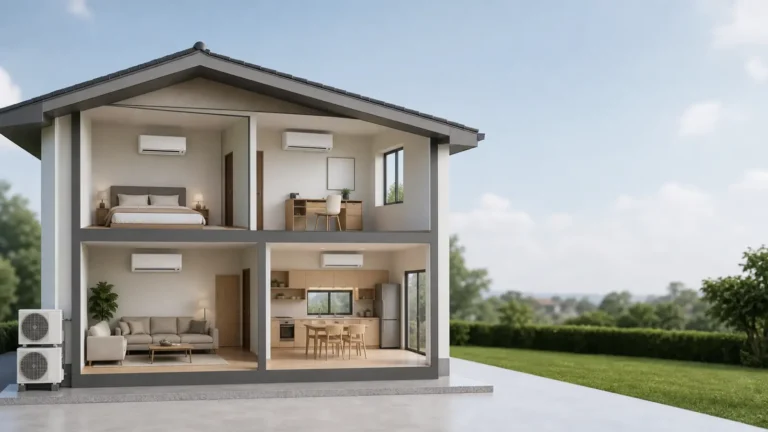 ComparisonsSingle-Zone vs Multi-Zone Mini-SplitsSingle-zone vs multi-zone mini-splits compared using DOE Building America guidance: part-load performance, cycling, oversized heads and when several outdoor units make sense.